
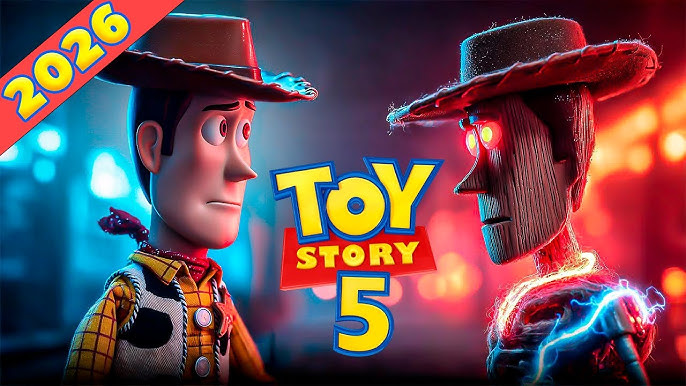
More than thirty years after audiences first met Woody and Buzz Lightyear, Pixar’s most famous toys have returned for another adventure.
Toy Story 5 opened in U.S. theaters on June 19, 2026, and continues attracting families throughout July.
The fifth main movie places Woody, Buzz, Jessie and the rest of the toys against an enemy that is very different from Sid, Stinky Pete, Lotso or Gabby Gabby.
 The Odyssey (2026): Cast, Story, Reviews, Box Office and Why Christopher Nolan’s Epic Is July’s Biggest Movie
Their new challenge is technology.
Bonnie receives a frog-shaped smart tablet named Lilypad, voiced by Greta Lee. The device quickly becomes the center of Bonnie’s attention and introduces a new question for the franchise: what happens to traditional toys when children prefer screens?
Lilypad is not simply an electronic object sitting in the background.
 Moana Live Action (2026): Cast, Songs, Differences, Reviews and Is Disney’s Remake Worth Watching?
She has her own personality, understands Bonnie’s social difficulties and believes technology can help the child connect with other people.
Jessie sees the situation differently.
As the new sheriff of Bonnie’s room, Jessie believes that imaginative play, physical toys and personal interaction are still important parts of childhood.
 TERCERA PARTE — «LA MANSIÓN ERA DE ÉL
This creates a conflict that is more complicated than toys fighting an obviously evil villain.
Both Jessie and Lilypad believe they are helping Bonnie.
Their disagreement concerns what kind of help Bonnie actually needs.
The film reunites Tom Hanks as Woody, Tim Allen as Buzz Lightyear and Joan Cusack as Jessie. It is directed by Andrew Stanton, co-directed by Kenna Harris and features an original score by longtime franchise composer Randy Newman.
Disney lists the movie with a PG rating and a runtime of approximately one hour and 42 minutes.
The movie has also become one of 2026’s largest commercial successes.
As of July 25, it has earned approximately US$966.2 million worldwide, placing it close to becoming another billion-dollar release for Pixar.
This complete guide covers the story, voice cast, characters, critical reception, themes, box-office performance, parental information and eventual streaming possibilities.
Toy Story 5 Quick Facts
Release date: June 19, 2026
Current availability: Movie theaters
Runtime: Approximately 1 hour and 42 minutes
Rating: PG
Genre: Animation, comedy, family adventure and fantasy
Director: Andrew Stanton
Co-director: Kenna Harris
Writers: Andrew Stanton and Kenna Harris
Story by: Andrew Stanton
Producer: Lindsey Collins
Composer: Randy Newman
Main voice cast: Tom Hanks, Tim Allen, Joan Cusack, Greta Lee, Tony Hale, Conan O’Brien, Craig Robinson, Annie Potts, Bonnie Hunt, Keanu Reeves, John Ratzenberger and Wallace Shawn
Central conflict: Traditional toys compete with a smart tablet for Bonnie’s attention.
Disney officially describes the premise as “Toy meets Tech,” with Woody, Buzz and Jessie facing Lilypad, a tablet that has her own ideas about what is best for Bonnie.
Why Toy Story 5 Is Trending in July 2026
The movie is trending because Toy Story remains one of the most recognizable and emotionally important franchises in animation.
The first film, released in 1995, transformed the movie industry as the first fully computer-animated feature film.
However, the franchise survived for more than three decades because audiences connected with its characters rather than only its technology.
Woody represented loyalty and the fear of being replaced.
Buzz represented identity and the difficulty of accepting an uncomfortable truth.
Jessie represented abandonment and the emotional pain toys experience when children grow older.
Every installment introduced a new stage in the relationship between children and their possessions.
Toy Story 5 continues that tradition by addressing a concern familiar to modern families: screen time.
Tablets, mobile phones, online games, messaging platforms and streaming videos compete directly with traditional forms of play.
Parents frequently struggle to balance the educational and social benefits of technology with concerns about isolation, dependence and reduced imagination.
The movie transforms that family discussion into a Pixar adventure.
Children can understand the basic conflict because they recognize tablets and toys.
Adults can recognize the larger questions about parenting, attention, social development and the role of technology in childhood.
The movie is also trending because Woody returns to Bonnie’s room.
At the end of Toy Story 4, Woody left Bonnie and joined Bo Peep’s group of traveling toys.
That decision appeared to create a permanent separation between Woody and his old friends.
Toy Story 5 finds a reason to reunite Woody with Buzz and Jessie without completely ignoring the emotional meaning of his earlier departure.
Popular searches surrounding the film include:
- Is Toy Story 5 worth watching?
- Why does Woody return?
- Who is Lilypad?
- Is Lilypad evil?
- Who voices the tablet?
- What happens to Jessie?
- Is Bo Peep in Toy Story 5?
- Is Toy Story 5 appropriate for children?
- How much money has the movie made?
- When will Toy Story 5 be on Disney+?
- Does the movie have a post-credit scene?
- Will there be a Toy Story 6?
- Is Toy Story 5 better than Toy Story 4?
These questions give the movie strong search value beyond its opening weekend.
Spoiler-Free Story Overview
Bonnie is now eight years old and beginning to question whether she is becoming too old for toys.
She remains creative and affectionate, but she has difficulty connecting with other children.
Her classmates are becoming increasingly interested in screens and online communication.
Bonnie receives Lilypad, a smart tablet designed with a friendly frog appearance.
Lilypad immediately attempts to help Bonnie become more social.
She introduces her to an online communication space called The Pond, where Bonnie can interact with friends from dance class.
The plan appears successful at first.
Bonnie feels included, and Lilypad provides an easier way to communicate without facing the discomfort of direct social interaction.
However, Jessie notices that Bonnie is spending less time using her imagination and playing with physical toys.
As the new sheriff of Bonnie’s room, Jessie believes her responsibility is to protect both the toys and their relationship with their child.
Her concern is not simply jealousy.
Jessie understands what it feels like to be forgotten by a child. She recognizes the possibility that Bonnie’s growing dependence on Lilypad could permanently change the way she plays.
Lilypad does not consider herself a threat.
She believes traditional toys are outdated and inefficient.
From her perspective, Bonnie needs access to communication, information and digital entertainment more than she needs dolls, cowboys or plastic dinosaurs.
The disagreement becomes increasingly serious as Jessie attempts to prove that imaginative play still matters.
During the conflict, Jessie and Bullseye become separated from the rest of the group.
Buzz Lightyear tries to maintain order inside Bonnie’s room, but the disappearance forces him to request help from an old friend.
Woody returns from his adventures with Bo Peep and reunites with Buzz to search for Jessie and Bullseye.
Meanwhile, Jessie encounters several forgotten technological toys, including Smarty Pants, Snappy and Atlas.
These characters represent earlier generations of electronic products that were once considered modern but eventually became outdated.
Their experiences complicate the movie’s central argument.
Technology is not automatically permanent.
A device celebrated as the future can eventually be forgotten in a drawer, shed or storage box when a newer product arrives.
The story therefore becomes more than a simple battle between toys and one tablet.
It examines whether different forms of play can coexist and what children lose when one type of entertainment completely replaces another.
Pixar’s official character descriptions confirm that Jessie leads the effort to help Bonnie make friends, becomes separated with Bullseye and meets several forgotten technological toys during her journey.
Tom Hanks as Woody
Tom Hanks returns as Woody.
Woody begins the movie away from Bonnie’s home, participating in toy-rescue missions with Bo Peep.
He has developed a more adventurous identity since leaving his previous child.
However, his loyalty to Buzz, Jessie and the other toys remains unchanged.
When he learns that Jessie and Bullseye are missing, Woody returns to help.
His presence is important because Toy Story 4 appeared to complete his emotional journey.
Woody accepted that he no longer needed to belong permanently to one child. He could find purpose by helping lost toys connect with people who needed them.
The fifth movie must therefore avoid making his earlier decision appear meaningless.
Woody does not simply move back into Bonnie’s room and pretend he never left.
He returns for a specific rescue mission and must decide how his new life fits with his old relationships.
His reunion with Buzz provides much of the franchise’s familiar emotional energy.
Woody and Buzz have disagreed repeatedly, but decades of friendship allow them to understand each other even when their lives move in different directions.
Hanks gives Woody the warmth and concern audiences expect while also presenting a cowboy who has become more comfortable with uncertainty.
Pixar describes Woody as returning after a surprise call and partnering with Buzz to locate Jessie and Bullseye.
Tim Allen as Buzz Lightyear
Tim Allen returns as Buzz Lightyear.
Buzz now serves as deputy to Sheriff Jessie.
The position shows how the leadership structure inside Bonnie’s room has changed since Woody’s departure.
Buzz supports Jessie instead of attempting to replace her.
When Jessie disappears, he becomes responsible for maintaining order and organizing the search.
The movie also introduces approximately fifty Hi-Tech Edition Buzz Lightyear figures.
These Buzz toys are stuck in space-ranger mode and believe they must return to Star Command.
The storyline recalls the original Buzz’s identity crisis from the first movie.
He once believed he was a real space ranger rather than a toy.
The newer figures allow him to see an exaggerated version of the person he used to be.
Their presence creates comedy, but it also gives Buzz an opportunity to reflect on how experience transformed his identity.
He is no longer the confused toy who needs Woody to explain reality.
Buzz has become a leader capable of helping others understand what it means to be a toy.
Pixar confirms that the new figures consist of fifty commemorative Buzz Lightyears stuck in toy mode and searching for Star Command.
Joan Cusack as Jessie
Jessie receives one of the movie’s most important roles.
She has become the sheriff of Bonnie’s room and feels personally responsible for protecting playtime.
This position represents significant character development.
Jessie entered the franchise as a toy traumatized by abandonment.
Her former child, Emily, eventually stopped playing with her and left her behind.
That experience explains why Bonnie’s attachment to Lilypad affects Jessie so strongly.
She does not view the tablet as only another popular object.
She sees the beginning of a process that may cause Bonnie to stop needing every traditional toy in the room.
Jessie’s fear is understandable, but it can also influence her decisions.
She may assume that protecting Bonnie means preventing change.
The movie challenges Jessie to distinguish between helping a child and attempting to control how that child grows.
Joan Cusack brings energy, humor and vulnerability to the character.
Jessie can lead a rescue mission, confront danger and still communicate the emotional fear of becoming unnecessary.
The focus on Jessie also prevents the fifth installment from functioning only as another Woody-centered story.
Greta Lee as Lilypad
Greta Lee voices Lilypad, the frog-shaped smart tablet.
Lilypad is one of the franchise’s most interesting antagonistic figures because she is not motivated by cruelty.
She genuinely believes she understands what Bonnie needs.
Her technology can connect Bonnie with other children, provide entertainment and help organize her social life.
From Lilypad’s perspective, the traditional toys are emotionally attached to an outdated version of childhood.
She views herself as progress.
This makes the conflict more complicated than defeating a villain who wants control for selfish reasons.
Jessie and Lilypad share one important quality: both will do almost anything to help Bonnie.
Their disagreement concerns whether real play, online communication or some combination of both will provide the healthiest future.
Greta Lee gives Lilypad a calm and intelligent voice.
The character rarely needs to behave like a traditional threatening machine.
Her confidence and ability to predict the other toys’ actions make her dangerous enough.
Pixar describes Lilypad as constantly remaining several steps ahead of the traditional toys while using The Pond to help Bonnie connect with classmates.
New Characters
Smarty Pants
Conan O’Brien voices Smarty Pants, an old toilet-training technology toy.
Smarty has spent years forgotten in a storage shed after his child moved beyond the stage for which he was designed.
His character demonstrates that electronic toys can become obsolete just as easily as traditional ones.
His sarcastic personality also introduces jokes aimed at older children and adults.
Snappy
Snappy is a small toy camera who values photographs and memories.
She has been trapped inside a junk drawer but remains enthusiastic about helping.
Her character represents a type of technology that preserves real experiences rather than replacing them.
Atlas
Atlas is a talking toy hippo equipped with GPS technology.
He becomes useful during the journey because he can guide the group.
Like Smarty and Snappy, Atlas was once considered technologically impressive before being forgotten.
Blaze
Blaze is a nine-and-a-half-year-old child who lives on a ranch and still enjoys toys despite being comfortable with technology.
Her character provides an alternative to the idea that children must choose completely between screens and physical play.
Forky and Karen Beverly
Tony Hale returns as Forky.
Forky and Karen Beverly are preparing to marry, creating one of the movie’s lighter side stories.
Forky remains fascinated by the meaning of life, trash and being considered a toy.
The wedding supplies humor while continuing the franchise’s tradition of giving emotional identities to ordinary objects.
Pixar’s official character guide introduces Smarty Pants, Snappy, Atlas, Blaze, Forky and Karen Beverly as part of the new adventure.
Returning Voice Cast
The movie includes an extensive group of returning and new performers.
Tom Hanks voices Woody, Tim Allen voices Buzz and Joan Cusack voices Jessie.
Tony Hale returns as Forky, Annie Potts returns as Bo Peep, Bonnie Hunt returns as Dolly and Wallace Shawn returns as Rex.
John Ratzenberger, Blake Clark, Kristen Schaal, Keanu Reeves and Alan Cumming also appear in the voice ensemble.
Craig Robinson, Conan O’Brien, Greta Lee, Mykal-Michelle Harris, Scarlett Spears and Matty Matheson are among the newer additions.
Disney’s official cast list contains more than twenty performers, demonstrating that the movie combines the established toy box with several new characters.
Andrew Stanton’s Direction
Andrew Stanton directs the movie.
Stanton is one of Pixar’s most important filmmakers.
His earlier directing credits include Finding Nemo, WALL-E and Finding Dory. He also contributed to the stories and screenplays of several earlier Pixar productions, including the original Toy Story films.
Kenna Harris serves as co-director and co-writer.
The filmmakers face a difficult creative challenge.
Both Toy Story 3 and Toy Story 4 were promoted as emotionally satisfying conclusions.
A fifth movie therefore needs to prove that another story is necessary rather than relying entirely on familiar characters.
The conflict with screens provides a contemporary reason to return.
The first movie focused on a new toy replacing an older favorite.
The fifth expands that basic fear by introducing a device capable of replacing the entire concept of physical play.
The filmmakers also created visual sequences showing Bonnie’s imagination.
Pixar explains that the team used a handmade, pastel-chalk style to distinguish Bonnie’s imaginative world from Andy’s earlier play sequences.
Animation and Visual Style
The animation demonstrates how far Pixar’s technology has progressed since 1995.
The original Toy Story was revolutionary, but its human characters, fabric, lighting and natural environments now appear simple compared with modern animation.
Toy Story 5 includes detailed materials, realistic shadows, complex environments and expressive character animation.
However, technical realism is not the only objective.
The film also enters Bonnie’s imagination, where ordinary toys become participants in handmade fantasy worlds.
The pastel textures and arts-and-crafts appearance help the movie preserve the imperfect creativity associated with childhood.
This visual decision supports the film’s message.
Lilypad offers polished, immediate digital entertainment.
Bonnie’s imagination is less technically perfect, but it is personal and unpredictable because she creates it herself.
The movie’s best animation therefore does not simply show realistic plastic or electronics.
It shows the difference between consuming entertainment and inventing a world through play.
What Works Best
The strongest element is the relevance of the central conflict.
Parents and children immediately understand the tension between toys and screens.
The movie does not need to explain why a tablet might absorb Bonnie’s attention.
The audience has probably experienced a similar situation at home.
Jessie’s expanded role is another major advantage.
Her history of abandonment makes her the ideal character to confront the possibility that Bonnie is moving beyond physical toys.
Woody’s return is also handled carefully enough to preserve some of the meaning of Toy Story 4.
He comes back because his friends need him rather than because his independent life completely failed.
Lilypad is another strength.
She is not a simple evil machine.
Her desire to help Bonnie makes the conflict more emotionally and morally complicated.
The animation has received widespread praise, particularly the sequences taking place inside Bonnie’s imagination.
The film also balances new themes with familiar humor.
Buzz’s upgraded duplicates, Forky’s wedding and the forgotten technological toys provide comedy that works for different age groups.
Critical reception has been strongly positive.
As of July 25, Rotten Tomatoes reports a 92% critics score from 315 reviews and a 94% verified-audience score. Critics have praised the animation, character work and timely discussion of screen use.
Possible Weaknesses
The greatest weakness is franchise repetition.
Every Toy Story movie asks whether toys still possess value when a child’s life changes.
The details are different, but the emotional pattern is familiar.
Some viewers may feel that the series has already explored abandonment, replacement and growing up several times.
The movie’s message about technology can also feel overly direct.
Parents may believe the story criticizes screen use without fully acknowledging how technology can support education, creativity and real social connection.
Lilypad provides some balance, but the traditional toys naturally receive the audience’s emotional loyalty.
The large cast creates another limitation.
Woody, Buzz, Jessie, Lilypad, Bonnie, Bullseye, Bo Peep, Forky and the new technological toys all compete for attention.
Several beloved returning characters receive relatively little individual development.
The movie must also justify reversing another apparent conclusion.
Toy Story 3 provided an emotional goodbye to Andy, while Toy Story 4 provided an emotional goodbye between Woody and Buzz.
Some viewers may believe continuing the story reduces the power of those endings.
Several critics have praised the fifth movie while still describing it as less essential and less emotionally powerful than the first three installments. Rotten Tomatoes’ review collection shows that even positive reactions frequently note the difficulty of matching Pixar’s earlier achievements.
Major Themes
Technology Versus Imaginative Play
The central theme is not simply that technology is bad.
Lilypad can genuinely help Bonnie communicate.
The problem begins when the screen replaces every other form of play and social interaction.
The movie argues for balance rather than complete rejection.
Fear of Becoming Obsolete
Every toy understands that children eventually grow older.
The forgotten technological characters reveal that even modern devices can become outdated.
Obsolescence is therefore not limited to cowboys, dinosaurs or dolls.
Anything designed for one stage of a child’s life may eventually lose its purpose.
Helping Versus Controlling
Jessie and Lilypad both believe they know what Bonnie needs.
Their conflict shows how protection can become control when adults, toys or technology stop listening to the child they claim to support.
Friendship Requires Adaptation
Woody and Buzz no longer live in the same place, but their friendship remains important.
The movie suggests that relationships can survive separation when people are willing to return during moments of genuine need.
Growing Up Does Not Mean Abandoning Creativity
Bonnie worries that her classmates will judge her for continuing to enjoy toys.
The movie challenges the idea that maturity requires rejecting imagination.
Creative play can change with age without disappearing completely.
Memories and Physical Objects
Snappy, Woody, Jessie and the other toys carry memories of children who once loved them.
Physical objects can become connected to experiences in a way that disposable digital content often does not.
However, the story also recognizes that preserving every object forever is impossible.
Who Should Watch Toy Story 5?
The movie is best suited for:
- Families with children
- Longtime Toy Story fans
- Pixar audiences
- Parents concerned about screen time
- Children who enjoy toys and technology
- Fans of Tom Hanks and Tim Allen
- Viewers interested in emotional animation
- Audiences seeking a summer family movie
- People who enjoyed Toy Story 3 and Toy Story 4
- Families looking for a movie that can create a discussion afterward
Watching the earlier movies provides greater emotional value but is not absolutely required.
New viewers can understand that Woody, Buzz and Jessie are living toys attempting to help Bonnie.
However, returning fans will better understand Woody’s departure, Jessie’s abandonment fears and Buzz’s long history of identity confusion.
The recommended viewing order is:
- Toy Story
- Toy Story 2
- Toy Story 3
- Toy Story 4
- Toy Story 5
Parental and Content Guide
Toy Story 5 is rated PG for thematic elements and rude humor. It runs approximately one hour and 42 minutes.
The movie is designed for families, but certain scenes may affect sensitive children.
Parents should consider:
- Toys becoming lost or separated
- Characters fearing abandonment
- Arguments about screen use
- Bonnie experiencing social anxiety
- Fast action and rescue sequences
- Multiple Buzz Lightyear figures behaving aggressively
- Toys placed in physical danger
- Rude jokes involving Smarty Pants
- Emotional discussions about growing up
- The possibility of toys no longer being needed
- Loud theatrical sound
- Moments involving dark or unfamiliar environments
The film does not contain graphic violence or adult sexual material.
Its more serious content involves emotional fears rather than physical injury.
Young children may become worried that their own toys feel lonely when they use a tablet.
Parents can explain that the movie uses fantasy characters to encourage balance and imagination.
Box-Office Performance
Toy Story 5 opened with approximately US$159.7 million in the United States and Canada.
As of July 25, 2026, it has earned approximately US$438.6 million domestically and US$527.7 million internationally, producing a worldwide total of roughly US$966.2 million.
The movie is approaching the US$1 billion milestone and has become one of 2026’s highest-grossing releases.
Its international performance demonstrates the global reach of the franchise.
Major totals include more than US$71 million from Mexico, US$60 million from the United Kingdom, US$41 million from Japan and US$41 million from China as of the current reporting date.
The commercial success confirms that audiences remain willing to return to established Pixar characters when the movie offers a recognizable emotional and contemporary conflict.
Box-office totals should always be updated because the film remains in theaters.
Where to Watch Toy Story 5
As of July 25, 2026, Toy Story 5 remains available in movie theaters.
Disney has not announced an official Disney+ streaming date.
The movie will probably move through several stages:
- Exclusive theatrical availability
- Premium digital purchase
- Digital rental
- Blu-ray, DVD and 4K release
- Disney+ subscription streaming
The timing will depend on Disney’s release strategy and the film’s continuing theatrical performance.
Because the movie is still earning significant box-office revenue, Disney may preserve a longer theatrical and digital window before adding it to Disney+.
Viewers should wait for an official announcement rather than trusting websites that publish estimated dates as confirmed facts.
Unofficial pages claiming to offer the full movie free may contain pirated material, malware or misleading subscription forms.
Will There Be a Toy Story 6?
Pixar has not officially announced Toy Story 6 as of July 25, 2026.
The fifth movie’s enormous commercial success makes another continuation financially possible.
However, the franchise repeatedly faces the same creative question: does another installment have a meaningful story to tell?
A sixth movie could explore:
- Bonnie becoming a teenager
- Jessie leading the toy group permanently
- Woody and Bo Peep’s rescue missions
- Buzz guiding newer toys
- The future of Lilypad
- Toys interacting with artificial intelligence
- Another child inheriting the characters
- The final retirement of Woody or Buzz
- Forky and Karen Beverly creating their own family
- A new generation replacing Bonnie’s toys
Until Disney or Pixar announces another project, Toy Story 6 should be treated as a possibility rather than a confirmed movie.
The fifth film’s ending may leave thematic opportunities, but box-office performance alone does not provide an official release date.
SEO Content Opportunities
Websites covering the movie can publish several related articles:
- Toy Story 5 ending explained
- Is Lilypad evil?
- Why does Woody return?
- What happens to Jessie and Bullseye?
- Every new character in Toy Story 5
- Who voices Lilypad?
- Toy Story 5 cast and character guide
- Is Toy Story 5 appropriate for children?
- Every Easter egg and Pixar reference
- The fifty Buzz Lightyears explained
- Forky and Karen Beverly’s wedding
- Toy Story 5 versus Toy Story 4
- All five Toy Story movies ranked
- The screen-time message explained
- When will Toy Story 5 be on Disney+?
- Does the movie have a post-credit scene?
- How much money has Toy Story 5 made?
- Will there be a Toy Story 6?
- Best Pixar movies for families
- The complete Toy Story viewing order
Internal links between these articles can help a website build authority around Pixar, animation, family entertainment and streaming releases.
Box-office and Disney+ information should be updated regularly.
Articles explaining the ending should contain clear spoiler warnings.
Final Verdict
Toy Story 5 is a surprisingly relevant continuation of Pixar’s longest-running franchise.
The movie finds a believable modern threat to the toys without simply introducing another jealous doll or violent child.
Lilypad represents the growing role of technology in childhood, but she is not presented as an empty symbol of evil.
She genuinely wants to help Bonnie.
That motivation gives the conflict more emotional complexity and prevents the movie from becoming only a lecture about tablets.
Jessie is the correct character to lead the story.
Her personal history with abandonment makes her fear of screen-based replacement understandable.
Joan Cusack gives the character enough energy and vulnerability to carry the emotional center of the film.
Woody and Buzz remain important, but the movie allows their reunion to support Jessie’s story rather than completely replacing it.
Tom Hanks and Tim Allen continue bringing warmth and familiarity to characters they have performed for more than three decades.
The animation is exceptional, especially the handmade visual style used to represent Bonnie’s imagination.
The forgotten technology toys also provide one of the movie’s smartest ideas.
They demonstrate that modern devices can become obsolete just as quickly as traditional toys.
The film is not entirely necessary.
Earlier installments already provided powerful endings, and several emotional ideas will feel familiar to longtime viewers.
However, Toy Story 5 justifies its existence better than many audiences expected.
It uses the franchise to discuss a real concern facing children and parents without abandoning adventure, comedy or emotion.
The movie may not surpass the original trilogy, but it remains one of Pixar’s strongest recent family productions.
Its 92% critics score, 94% verified-audience rating and nearly US$1 billion global performance demonstrate that the toys still possess extraordinary cultural and commercial power.
Families should watch it together and discuss the central message afterward.
The most useful question is not whether children should completely stop using technology.
It is whether screens, toys, imagination and real friendships can exist in a healthier balance.
Frequently Asked Questions
When was Toy Story 5 released?
Disney and Pixar released the movie in U.S. theaters on June 19, 2026.
Where can I watch Toy Story 5?
As of July 25, 2026, the movie is available in theaters.
Is Toy Story 5 on Disney+?
No official Disney+ release date has been announced yet.
How long is Toy Story 5?
The movie runs for approximately one hour and 42 minutes.
What is Toy Story 5 rated?
It is rated PG for thematic elements and rude humor.
What is Toy Story 5 about?
The toys face a new challenge when Bonnie receives Lilypad, a smart tablet that begins replacing traditional playtime and encourages Bonnie to communicate with friends online.
Who voices Woody?
Tom Hanks returns as Woody.
Who voices Buzz Lightyear?
Tim Allen returns as Buzz Lightyear.
Who voices Jessie?
Joan Cusack returns as Jessie.
Who voices Lilypad?
Greta Lee voices Lilypad.
Is Lilypad evil?
Lilypad functions as the main opposing force, but she genuinely believes she is helping Bonnie. Her disagreement with Jessie concerns the best way to support their child.
Why does Woody return?
Woody returns after learning that Jessie and Bullseye are missing and that his old friends need help.
Is Bo Peep in Toy Story 5?
Yes. Annie Potts returns as Bo Peep, although the main story focuses more heavily on Woody, Buzz, Jessie and Lilypad.
What happened to Jessie?
Jessie has become the sheriff of Bonnie’s room. She becomes separated from the group while attempting to protect Bonnie’s relationship with imaginative play.
Are there multiple Buzz Lightyears?
Yes. The movie includes fifty Hi-Tech Edition Buzz Lightyear figures that believe they must return to Star Command.
Does Forky return?
Yes. Tony Hale returns as Forky, who is preparing to marry Karen Beverly.
Who directed Toy Story 5?
Andrew Stanton directed the movie, with Kenna Harris serving as co-director.
Who composed the music?
Randy Newman returned to compose the score for his fifth main Toy Story movie.
Is Toy Story 5 appropriate for children?
It is designed for families, although sensitive children may react to separation, abandonment fears, dangerous rescue scenes and the discussion about toys becoming unnecessary.
Do I need to watch Toy Story 4 first?
Watching the fourth movie is recommended because it explains why Woody lives away from Buzz, Jessie and Bonnie.
Is Toy Story 5 better than Toy Story 4?
Preference will vary. The fifth movie has a more contemporary central conflict and gives Jessie a larger role, while the fourth focuses more directly on Woody’s search for a new purpose.
What are the reviews like?
As of July 25, Rotten Tomatoes reports a 92% critics score and a 94% verified-audience score.
How much money has Toy Story 5 made?
The movie has earned approximately US$966.2 million worldwide as of July 25, 2026. The total continues changing while it remains in theaters.
Will Toy Story 5 make one billion dollars?
The movie is close to the milestone, but future box-office performance will determine whether and when it crosses US$1 billion.
Will there be a Toy Story 6?
Pixar has not officially announced a sixth main movie.
Is Toy Story 5 worth watching?
Yes. It is especially worthwhile for families, longtime fans and viewers interested in a Pixar story about screen time, imaginative play and the fear of becoming obsolete.